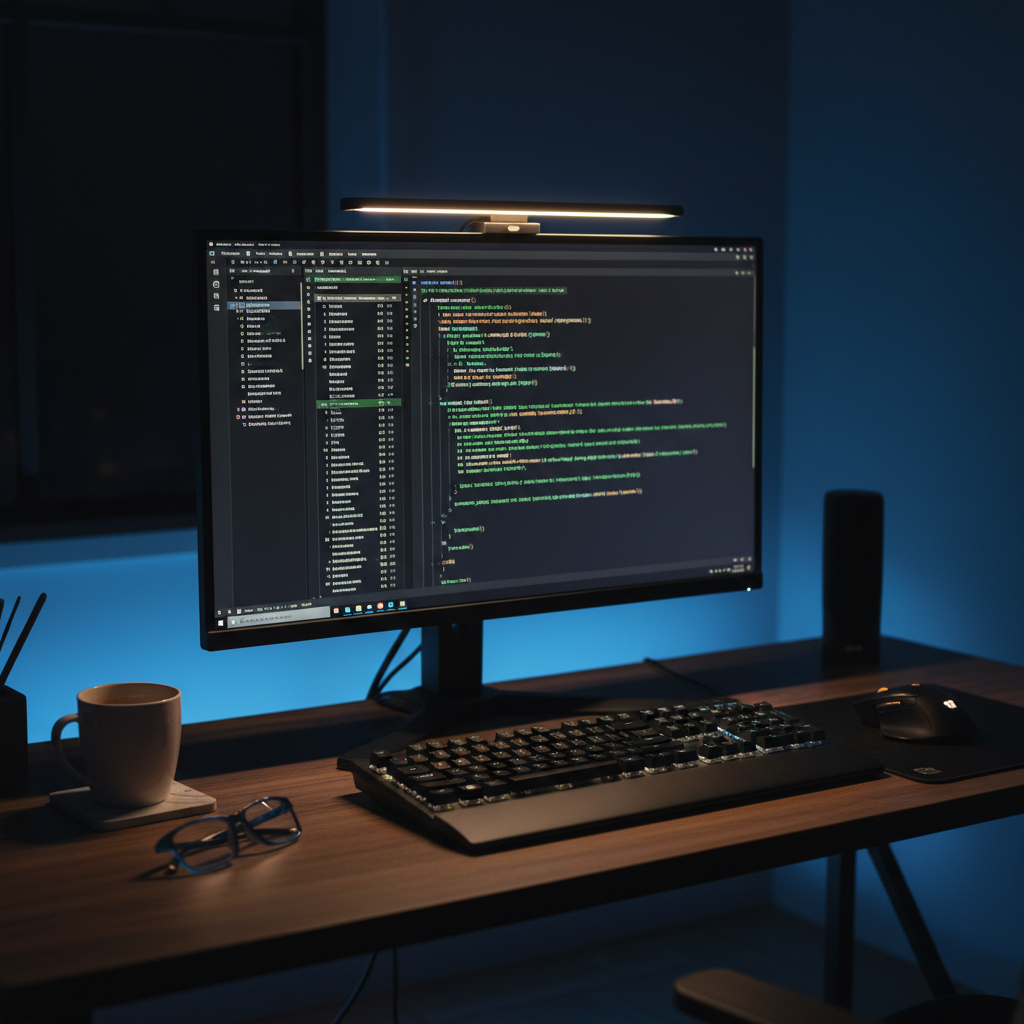
For countless programmers, the late hours bring a unique kind of focus. As the world quietens, the lines of code on a glowing screen become the sole focus. Yet, this immersive, dim environment, often referred to as the “coding cave,” comes with a hidden cost: significant eye strain. The stark contrast between a bright monitor and a dark room forces your eyes into constant, tiring adjustments, leading to fatigue, headaches, and even disrupted sleep. Fortunately, monitor light bars have emerged as an indispensable tool, offering a targeted solution to illuminate your workspace without sacrificing the cherished dark-room ambiance.
This comprehensive guide delves into the specific challenges faced by coders at night and reveals how the right monitor light bar can transform your coding experience, protecting your eyes and boosting your productivity. We’ll explore essential features, compare top models, and help you select the perfect lighting companion for your late-night coding sessions.
The Unique Challenges of Coding at Night
Working in a dimly lit or dark room, while seemingly beneficial for concentration, poses several direct threats to your visual health and overall well-being. Understanding these challenges is the first step toward finding an effective solution.
Eye Strain & Fatigue
|
Our Picks for the Best Desk lamp in 2026
As an Amazon Associate I earn from qualifying purchases.
|
||
| Num | Product | Action |
|---|---|---|
| 1 | Motumen Led Desk Lamp for Home Office, Eye-Care Architect Light with Clamp, Smart Double Head Computer Monitor Table Clip Lamp, Adjustable Flexible Goose-Neck, 25 Lighting Models, Task Lamp, Black |

|
| 2 | Fenmzee Bedside Table Lamp for Bedroom - 3 Way Dimmable Touch Lamp USB C Charging Ports and AC Outlet, Small Lamp Wood Base Round Flaxen Fabric Shade for Living Room, Desk, LED Bulb Included |
|
| 3 | Micomlan Led Desk Lamp with Clamp, Architect Desk Lamp for Home Office with Atmosphere Lighting, 24W Ultra Bright Auto Dimming Computer Light Stepless Dimming and Tempering LED Table Light |
|
| 4 | BOHON LED Desk Lamp with USB Charging Port 3 Color Modes Dimmable Reading Light Intelligent Induction Auto Dimming Task Lamp Neck Flexible Table Lamp for Bedside Office, AC Adapter Include |
|
| 5 | 15W LED Desk Lamp with USB Charging Ports – Dimmable Table Lamp with 3 Color Temps, 5 Brightness, 4 Timers, Flexible Gooseneck Light with Base, Eye-Caring Reading Light for Home Office, Bedroom, Study |
|
| 6 | Voncerus LED Desk Lamp with Clamp, Eye-Caring Clip on Lights for Home Office, 3 Modes 10 Brightness, Long Flexible Goose-Neck, Metal, Swing Arm Architect Task Table Lamps with USB Adapter, Black |
|
| 7 | Airlonv LED Desk Lamp for Office Home, Eye-Caring Desk Light with Stepless Dimming Adjustable Flexible Gooseneck, 10W USB Adapter Desk Lamp with Clamp for Reading, Study, Workbench (Black) |
|
| 8 | LED Desk Lamp with USB Ports,Touch Desk Lamps for Home Office with 5 Color Modes,3 Brightness Desk Light with Small Night Light,Reading Lamp Table Lamp for Bedroom Bedside Study Black (with adapter) |
|
| 9 | CHARYJOD LED Desk Lamp for Office Home, Height Adjustable Architect Desk Light with USB Adapter, Stepless Dimming Desk Lamp Light for Reading, Study, Workbench |
|
| 10 | Sailstar Desk Lamp, LED Desk Lamps for Home Office, Wireless Charger Small Desk Lamp with Pen Holder, 3 Color Modes, Dimmable, CRI 85, 800LM, Study Lamps for College Dorm Room, Adapter Included, Black |
|
In a dark environment, your monitor becomes the dominant light source. Your pupils naturally dilate to let in more light, making your eyes highly sensitive to the intense glow from the screen. This extreme contrast between the bright display and the dark surroundings forces your eyes into continuous readjustment, a phenomenon known as “contrast glare.” Over extended coding hours, this constant effort leads to pronounced eye strain, dryness, burning sensations, and even headaches. The long-term impact can affect visual acuity and overall eye health.
Disrupted Circadian Rhythm
The type of light you’re exposed to, especially at night, plays a critical role in regulating your body’s natural sleep-wake cycle, or circadian rhythm. Bright, cool-toned light from screens can suppress melatonin production, making it harder to fall asleep and achieve restful sleep after a late-night coding session. This disruption not only affects your rest but can also impact your mood, concentration, and productivity the following day.
Glare & Reflections
Traditional desk lamps, while providing light, often create more problems than they solve for coders. They typically shine light directly onto your screen, causing irritating reflections and glare that obscure text and graphics. This forces you to squint or adjust your posture uncomfortably, adding to eye and neck strain. In a dark room, even subtle reflections can be highly distracting, breaking your immersion and workflow.
How Monitor Light Bars Solve These Problems
Monitor light bars are specifically engineered to address the unique lighting needs of computer users, particularly those working in dim conditions. They offer a sophisticated approach to illumination that tackles eye strain, glare, and circadian rhythm disruption head-on.
Asymmetrical Lighting: Eliminating Screen Glare
One of the most crucial innovations in monitor light bar technology is asymmetrical lighting. Unlike conventional lamps that cast light broadly, monitor light bars with asymmetrical design project light at a precise angle downwards onto your desk and keyboard, without hitting the monitor screen. This ingenious design prevents any reflective glare on your display, ensuring clear visibility of your code and documents while adequately illuminating your physical workspace. This feature is paramount for reducing eye strain and maintaining focus during long coding sessions.
Bias Lighting: Reducing Contrast & Enhancing Immersion
Another advanced feature, often found in premium monitor light bars, is bias lighting. This involves a secondary light source integrated into the rear of the light bar, which gently illuminates the wall behind your monitor. By creating a soft glow around the screen, bias lighting effectively reduces the harsh contrast between your bright display and the dark room. This visual balance lessens the effort your eyes exert to adapt, thereby minimizing eye fatigue. Furthermore, it helps maintain the immersive “coding cave” atmosphere by providing ambient light without disrupting the screen’s focus.
Adjustable Color Temperature: Supporting Circadian Rhythms
Monitor light bars with adjustable color temperature allow you to tailor the light’s warmth to the time of day. Measured in Kelvin (K), cooler, bluer light (e.g., 4000K-5000K) is invigorating and ideal for daytime concentration. However, for nighttime coding, switching to warmer, amber-toned light (e.g., 2700K-3500K) is essential. This warmer spectrum mimics natural evening light, reducing the emission of blue light that can interfere with melatonin production and sleep patterns. By aligning your workspace lighting with your circadian rhythm, you can minimize sleep disruption and promote better rest.
Precision Brightness Control: Optimal Illumination
Effective monitor light bars offer a wide range of brightness levels, often with stepless dimming, allowing you to fine-tune the illumination precisely to your environment and personal preference. This means you can achieve the perfect balance: enough light to see your keyboard and desk clearly, but not so much that it causes discomfort or overwhelms your eyes in a dim room. Some advanced models even include auto-dimming features, using ambient light sensors to automatically adjust brightness to maintain an optimal 500 lux level, which is recommended for office lighting.
Key Features to Look for in a Monitor Light Bar
When selecting the ideal monitor light bar for your coding setup, consider the following features to ensure maximum comfort, functionality, and eye protection.
Asymmetrical and Bias Lighting (Dual Light Source)
Prioritize models that explicitly mention asymmetrical lighting to prevent screen glare. For those who frequently code in near-total darkness, a monitor light bar with both front (asymmetrical) and rear (bias) lighting is a game-changer. The rear bias light significantly enhances eye comfort by softening the contrast between your screen and the background, making it easier for your eyes to adjust.
Color Temperature Range
Look for a wide color temperature range, typically from 2700K (warm white) to 6500K (cool white) or higher. This versatility allows you to switch between bright, cool light for daytime focus and warm, amber light for late-night sessions, which is crucial for protecting your sleep cycle.
Brightness Adjustability
A good monitor light bar should offer stepless dimming, allowing you to precisely control the light intensity from 5% to 100%. Auto-dimming, while not essential, is a convenient feature that automatically adjusts the light based on ambient conditions, ensuring consistent and optimal illumination throughout your work session.
Control Mechanisms
The ease of adjusting your light bar can significantly impact your user experience.
- Wireless Pucks: These external controllers are highly favored for their convenience and precision. They allow you to easily adjust brightness and color temperature without reaching for the light bar itself, often with tactile feedback.
- Touch Sensors: While common on more affordable models, touch sensors on the light bar can sometimes be overly sensitive or awkward to use, especially for stepless adjustments.
Mounting System Compatibility
Ensure the light bar’s mounting system is compatible with your monitor. Most use a weighted clamp design. Check if it fits your monitor’s thickness (e.g., from 0.2 inches to 2.3 inches) and if it supports curved monitors (e.g., from 1000R to 1800R curvature) if you have one. A stable and versatile mount is critical to prevent wobbling or obstruction of your webcam.
Build Quality & Durability
Invest in a monitor light bar made from quality materials that promise durability. While more expensive, premium brands often offer superior construction and optical engineering, which translates to better performance and longevity.
Top Monitor Light Bars for Coders
Based on expert reviews and user feedback, here are some of the best monitor light bars that cater to the specific needs of programmers coding at night.
BenQ ScreenBar Halo / Halo 2
Considered the gold standard for many professionals, the BenQ ScreenBar Halo is a premium choice designed with coders in mind.
- Pros: It features both front asymmetrical lighting and a unique rear bias light, offering comprehensive eye protection by eliminating screen glare and reducing contrast. The wireless puck provides precise, digital control over brightness and color temperature, with the ability to save favorite settings. It also includes an auto-dimming function and a versatile mounting system suitable for most monitors, including curved ones.
- Cons: Its primary drawback is the higher price point.
BenQ ScreenBar
The original BenQ ScreenBar offers many of the premium features of the Halo without the rear bias lighting or wireless puck.
- Pros: It excels at asymmetrical lighting, effectively eliminating screen glare. It provides a wide range of color temperature options (2700K-6500K) and 15 brightness levels, along with auto-dimming. The robust mounting system is highly versatile.
- Cons: It lacks the immersive bias lighting of the Halo model and uses on-bar touch controls instead of a wireless puck.
Xiaomi Mi Light Bar
A strong contender in the mid-range segment, the Xiaomi Mi Light Bar offers excellent value, particularly for its inclusion of a wireless control puck.
- Pros: Its standout feature is the convenient wireless puck for easy brightness and color temperature adjustments. It uses a magnetic system for attaching the light bar to its mount, offering some rotational flexibility.
- Cons: While good, its asymmetrical lighting may not be as effective as BenQ models, potentially leading to some minor light bleed onto the screen.
Quntis ScreenLinear Pro
Often an Amazon bestseller, the Quntis ScreenLinear Pro is a popular mid-range option known for its accessibility.
- Pros: It’s a more affordable option with a reliable weighted mounting system. It offers touch controls for brightness and color adjustments, including stepless dimming.
- Cons: Similar to other mid-range bars, it may struggle with perfect asymmetrical lighting, resulting in noticeable light bleed onto the screen. The touch sensors can be less intuitive than a wireless puck for fine adjustments.
Baseus Light Bar
For budget-conscious coders, the Baseus Light Bar offers an entry-level solution.
- Pros: It’s very affordable and features a pivoting head for aiming light. It includes touch sensors for three color settings (warm, neutral, cool white) and stepless dimming.
- Cons: Reviews often note that its asymmetrical lighting is not as effective, leading to light bleed onto the screen. The touch sensors can be overly sensitive, making precise adjustments challenging.
Choosing the Right Monitor Light Bar for Your Coding Setup
Selecting the best monitor light bar involves a careful assessment of your personal needs, workspace, and budget.
Determine Your Usage Needs
- Coding in total darkness? If you frequently code in a pitch-black room, a light bar with bias lighting (like the BenQ ScreenBar Halo) will be most beneficial for eye comfort.
- Already have some ambient room lighting? If your room isn’t completely dark, a high-quality asymmetrical light bar (like the BenQ ScreenBar) might suffice.
- Do you need to illuminate your keyboard and desk? All good monitor light bars aim to do this without screen glare, but some perform better than others.
Consider Your Workspace and Monitor
- Monitor type: Ensure the mounting system is compatible with your monitor’s thickness and curvature (if applicable).
- Desk space: A light bar frees up desk space compared to a traditional desk lamp.
- Existing lighting: How will the light bar integrate with any other lighting in your room?
Budget
Monitor light bars range significantly in price, from budget-friendly options around $30-$50 to premium models costing upwards of $150-$200. While cheaper options offer basic functionality, investing in a mid-range or premium bar often provides superior optical design, better eye protection, and more convenient controls. Consider the long-term benefits to your eye health and productivity when setting your budget.
Read Reviews and Comparisons
Always consult professional reviews and user feedback, particularly from other programmers or long-term computer users. Pay attention to comments regarding asymmetrical lighting performance, glare, ease of use, and overall eye comfort.
“For late-night coding, the greatest relief comes from a perfectly balanced light source that banishes glare and eases the transition between screen and surroundings. It’s not just about light; it’s about intelligent light.” – Admin, ReviewsBR.com, Desk Lamp Specialist
Conclusion
Coding at night doesn’t have to be a trade-off between intense focus and painful eye strain. With the right monitor light bar, programmers can create an optimally illuminated workspace that protects their eyes, supports their circadian rhythm, and enhances productivity. By understanding the importance of asymmetrical and bias lighting, adjustable color temperatures, and precise controls, you can make an informed decision. Investing in a high-quality monitor light bar like the BenQ ScreenBar Halo or ScreenBar can be a game-changer, transforming your late-night coding sessions into more comfortable, sustainable, and enjoyable experiences.
Are you ready to illuminate your coding cave smarter, not just brighter?
Câu Hỏi Thường Gặp
What color temperature is best for coding at night?
For coding at night, a warmer color temperature between 2700K and 3500K (warm white to soft white) is generally recommended. This range reduces blue light emission, which can interfere with melatonin production and disrupt your sleep cycle. Switching to warmer light helps your body prepare for rest after extended screen time.
Do monitor light bars cause glare on the screen?
Quality monitor light bars are specifically designed with asymmetrical optics to prevent glare. They direct light downwards onto your desk and keyboard, illuminating your physical workspace without casting any reflections onto your monitor screen. This targeted illumination is a key benefit over traditional desk lamps.
Is bias lighting really necessary for programmers?
Bias lighting, which illuminates the wall behind your monitor, is highly beneficial for programmers, especially those working in dark rooms. It significantly reduces the harsh contrast between your bright screen and the dark background, minimizing eye strain and fatigue, and helping to maintain visual comfort and immersion.